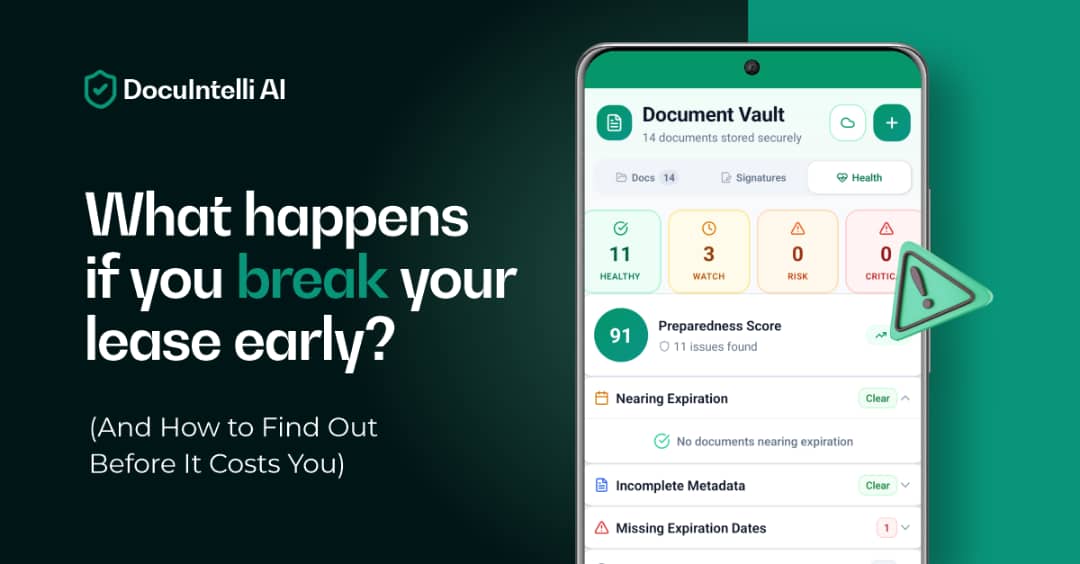
What Happens If You Break Your Lease Early? (And How to Find Out Before It Costs You)
Your documents know things you have forgotten.
Somewhere between "I think I want to move" and "I need to move," there is a moment most renters skip. The moment where you open your lease and check what it actually says about leaving early.
Most people skip it because they assume they know the answer. "There is probably a fee." Or they skip it because the lease is 14 pages of legal text and they do not have an hour to find the right paragraph. Or they skip it because they signed the lease 9 months ago and genuinely forgot where it is.
Whatever the reason, the moment passes. And the next time the lease comes up is the day they hand in their notice and find out what they owe.
By then it is too late to negotiate. Too late to plan around it. Too late to do anything except pay.
This post is about that moment. What is actually inside your lease's early termination clause, how much it typically costs, and how to find the exact answer in your specific lease in seconds instead of scrolling through 14 pages hoping you find it.
What the data says about reading leases
According to the State of Resident Onboarding 2026 report, only 37% of renters read their entire lease before signing. 28% read certain sections. 18% skimmed it. And 10% did not read it at all.
That means 6 out of 10 renters signed a legally binding contract without fully reading it.
A Harvard Law and Economics Center study went further. It examined 70 residential leases and found that 97% contained at least one unenforceable clause and 100% contained at least one misleading clause. The researchers noted that tenants, like most consumers, often do not read their leases before signing but are likely to read them after a dispute arises.
Read that again. People read their lease for the first time when something has already gone wrong.
This is the environment you are operating in. You signed a document you did not fully read. It contains clauses that may not even be enforceable. And the first time you will look at it closely is the day you need something from it. That is not a personal failure. That is a system that was built for signing, not for understanding.
What an early termination clause actually says
Most residential leases include an early termination clause somewhere between pages 2 and 5. The clause typically covers three things:
How much notice you need to give. This ranges from 30 to 90 days of written notice before your lease end date. Not before the day you want to leave. Before the end of the lease term. If your lease ends August 31 and requires 60 days notice, your deadline is July 1. If you decide to move on July 15, you are already two weeks late.
What the penalty is. Early termination fees vary widely. The most common structures include a flat fee (one to three months rent), a percentage of remaining rent, or liability for rent until the landlord finds a new tenant. A Seattle renter on Blind reported a $9,000 penalty for breaking a 13-month lease. A Georgia analysis showed that a tenant with 6 months remaining on a $1,500/month lease could face an initial liability of $9,000 before the landlord's duty to re-rent kicks in.
What conditions apply. Some leases allow early termination without penalty under specific circumstances: military deployment under the Service members Civil Relief Act, domestic violence (in many states), uninhabitable conditions the landlord failed to fix, or a job relocation clause if one was negotiated. Your lease specifies which of these apply. If you do not check, you will not know.
The early termination clause also usually addresses what happens to your security deposit. Some leases explicitly state that the deposit cannot be used to offset the termination fee. Others allow it. The difference between getting $1,500 back and losing $1,500 is a sentence on page 3 you may have never read.
The auto-renewal trap
There is a second deadline inside your lease that most renters do not know about. The auto-renewal clause.
Many leases automatically renew for another full term if you do not give written notice by a specific date. Not a phone call. Not a text to your landlord. Written notice, delivered within a window that is defined in the lease.
If your lease requires 60 days notice before auto-renewal and you miss that window by even one day, you may be legally committed to another 12 months. Your options at that point are limited: stay for the full new term, or pay the early termination fee to get out of a lease you never intended to renew.
The auto-renewal date is different from your lease end date. It is earlier. Sometimes 30 days earlier. Sometimes 90 days earlier. And it is almost always buried in the middle of the document, not highlighted, not bolded, and not mentioned during the walk-through at signing.
As Professor Bennie Waller of Longwood University puts it: "The biggest mistake renters make is not understanding their lease. Many tenants sign the lease without reading or understanding the consequences."
What this costs in real money
The financial impact of not knowing your early termination terms goes beyond the termination fee itself.
If you miss your notice window and auto-renew into a year you did not want, you are either paying 12 more months of rent or paying a termination fee to escape. On a $1,500/month apartment, that is either $18,000 in unwanted rent or $3,000 to $4,500 in termination fees. Both triggered by a date on page 2 that nobody checked.
If you do not know your security deposit terms, you may agree to move-out conditions that cost you more than necessary. Some leases define "normal wear and tear" specifically. Others leave it vague, giving the landlord discretion. The difference between a $200 deduction and a $1,200 deduction is often a definition on page 7.
If you break your lease in a state where the landlord has a "duty to mitigate damages" (meaning they must make a reasonable effort to re-rent the unit), you may owe significantly less than the termination clause suggests. But you will not know to invoke that right if you have not read the clause.
The money is real. The information that protects you is on pages you have never opened.
How to find your answer in seconds
Everything in the previous sections lives inside a document you already have. Your lease. The notice period. The termination fee. The auto-renewal date. The security deposit terms. The duty to mitigate. All of it is in there, on specific pages, in specific sections.
The traditional way to find these answers is to open the PDF, scroll through 14 pages of legal language, try to identify the right clause, cross-reference the sections it mentions, and hope you are reading it correctly. Most people who try this give up before they find what they need. That is not a guess. The data says 63% of renters did not fully read their lease before signing it. They are not going to fully read it now.
DocuIntelli AI was built for exactly this moment.
Upload your lease. It reads every page. Then ask it anything in plain English.
"What happens if I break my lease early?" Early termination fee: two months rent. 60 days written notice required. Security deposit may not be applied toward the fee. Section 3, page 2.
"When does my lease auto-renew?" Your lease auto-renews on August 31 unless 60 days written notice is provided. Your notice deadline is July 1. Section 5, page 4.
"What is the definition of normal wear and tear?" Nail holes, minor scuffs, and carpet wear from normal foot traffic. See Section 11, page 7.
"Does my landlord have a duty to mitigate?" Your state requires landlords to make a reasonable effort to re-rent the unit. Your liability reduces by each month the unit is occupied by a new tenant.
The answers come back in seconds. Powered by Okestra AI. With the exact page, the exact section, and the exact language from your specific lease. Not a blog post about leases in general. Not a Reddit thread from someone in a different state with a different lease. Your document. Your answer.
The moment that matters
You are going to move eventually. Everyone does. When that moment comes, you will either know your terms or you will not.
If you know your notice deadline, you send the letter on time. If you know the termination fee, you plan for it or negotiate around it. If you know your security deposit terms, you document the apartment accordingly. If you know the auto-renewal date, you never get locked into a year you did not choose.
All of this takes five minutes. One upload. One question. One answer you did not know was sitting in your own lease.
The people who get caught by their lease are not irresponsible. They are the same people who file their documents carefully, save them in the right folder, and trust that they are covered. The document was always there. The information inside it was not accessible until now.
DocuIntelli AI is free to start. No credit card. No trial expiration. Starter is $9/month. Pro at $15/month.
Upload your lease right now. Ask it what happens if you break it early. See what comes back.
Frequently Asked Questions
How much does it cost to break a lease early?
It depends on your specific lease. The most common structures are a flat fee of one to three months rent, a percentage of remaining rent on the lease, or liability for rent until the landlord re-rents the unit. Penalties of $3,000 to $9,000 are common for apartments in the $1,500/month range. Your exact fee is in your early termination clause, usually on page 2 or 3 of your lease.
Can my landlord keep my security deposit if I break my lease?
Some leases allow the security deposit to be applied toward the early termination fee. Others explicitly prohibit it. The answer is in your lease's deposit clause, usually a separate section from the termination clause. If your lease says the deposit cannot offset the termination fee, you owe both: the full fee plus any deductions from your deposit for damages. Check your lease before assuming the deposit covers you.
What is a lease auto-renewal clause?
An auto-renewal clause automatically extends your lease for another full term if you do not give written notice by a specific deadline. This deadline is earlier than your lease end date, sometimes 30 to 90 days earlier. If your lease ends August 31 and requires 60 days notice, your auto-renewal deadline is July 1. Missing it by even one day can lock you into another 12 months.
How much notice do I need to give my landlord before moving out?
Most residential leases require 30 to 90 days of written notice before the end of the lease term. The exact number of days is in your lease. Written means a letter or email, not a phone call or verbal conversation. The notice period applies to the lease end date, not the date you want to leave. If you plan to leave mid-lease, the early termination clause governs, not the notice period.
Can I break my lease without penalty?
In some cases, yes. Federal law allows active military members to break a lease without penalty under the Service members Civil Relief Act. Many states allow penalty-free termination for domestic violence survivors, for tenants in uninhabitable conditions the landlord refused to fix, or for tenants who need to enter assisted living or long-term care. Some leases include a job relocation clause. Your lease and your state laws together determine whether you qualify. If your lease does not mention an exception, ask DocuIntelli AI to check for you.
How do I find the early termination clause in my lease?
You can scroll through the PDF manually and look for sections titled "Early Termination," "Lease Termination," "Breaking the Lease," or "Default." This is usually between pages 2 and 5. Or you can upload your lease to DocuIntelli AI and ask "what happens if I break my lease early?" The answer comes back in seconds with the exact clause, page number, and section cited. Free to start at docuintelli.com.